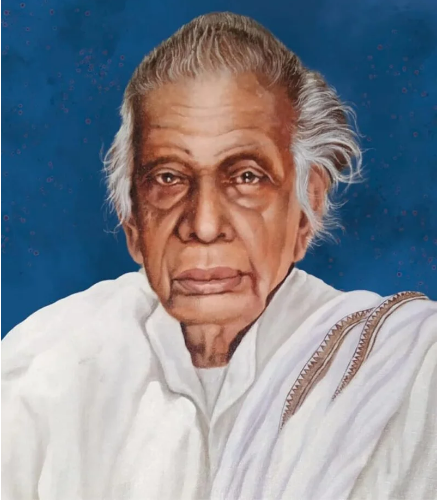
This story was presumably intended to be the last story by Achyutananda Pati, the centenarian storyteller who enters the 100th year of his life on 22 June 2026. The writer himself makes this intention clear in the concluding paragraph of the story, as follows:
“The storyteller wrapped up the story. He cast aside his pen. Maybe this could be his last story as well. The milestone of a hundred-year lifespan was inching towards him.”
Written in his mother tongue, Odia, under the title Sesha Silpa a couple of months before he entered his 100th year, the story was published in the leading Odia daily Sambad, accompanied by an editorial note stating: “This could be the writer’s last story.”
But that was not to be. A few weeks after its publication, the author picked up his pen once again and settled down to write another story. Both stories have been included in a significant collection of his recent works, scheduled for release on 22 June 2026 by Sambad–Ama Odisha to mark the commencement of his 100th year.
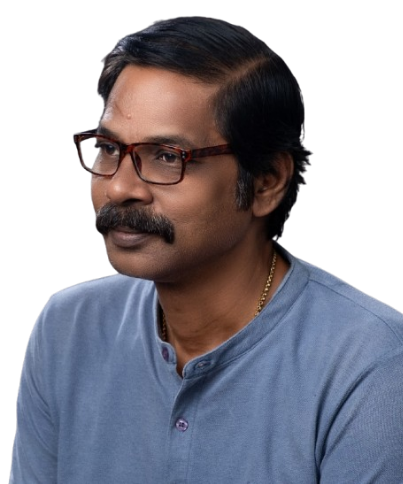
We present here a translation of the landmark story, Sesha Silpa, rendered into English by Sukomal Dash.
— Editor
There was a kingdom. There was a king. There were subjects.
The kingdom was prosperous. The king was benevolent. The subjects were blessed.
At every point, at every place, felicity rippled. The ceaseless sound of hurrah and ‘hulahuli’ – the auspicious sound made by twisting the tongue – exalted the land. Flowers of joy flourished, diffusing the sweet smell of well-being.
Reciting metrical couplets and lores on benignity, the king enchanted and enamoured everyone with his gestures. The subjects took turns to attend to the king and take care of him. Whenever the king bellowed, ‘Anyone out there!?’ someone rushed to him in a wink: ‘Ji hazoor!’ The king and his subjects reciprocated such love.
The king had queer whims. He had a unique taste. He was engrossed in his own world. He didn’t have any greedy attraction for the feminine body, but did have a dreamy, artistic addiction to it.
He decorated his art gallery with statues of slim, feminine figures. Respecting the treasure of feminine beauty was the goal of his life. Considering his magnanimity, it wouldn’t be freakish to hail him as the second Vikramaditya.
The figures were glossy, lively. They carried an ocean of burning physical beauty, wild and youthful. If analysed a bit, the protrusion of their haughty, defiant bosoms agitated the senses of the viewer.
The tinge of a sweet smile adoring the lips of the figures was inviting, seducing.
If the figures were such, and their features were such, just imagine how they would affect the viewer! The souvenirs of the king’s gallery were proportionate on various grounds. Some figures were gratifying, butter-like, dancing, the image of a danseuse adorned like a classical Odia beauty. Her Odia saree of broad hem was pinned to her waist by a girdle of tiny jingling bells. Armlets adorned the sculptures’ arms, and their bangles tinkled like banyan berries. Feet in a dancing pose displayed anklets. The slender waist, akin to that of a lion, was twisted in an unrivalled pose. The palms displayed a mild dancing poetic gesture.
Somewhere, the figure was a passionate, lusty drummer. The ‘Mrudanga’ drum dangled, pressing against the swell of her chest. The fingers of her right hand displayed the playing mode, while the base of her left palm was primed for rubbing and beating.
Somewhere there was ‘Badhu Nirūpamā’ – the unparalleled, charming, iconic Odia bride. A thin veil covered the knot of her hair. A round vermillion dot below the veil. A line of vermillion at the parting of the hair, and a sidelong, cryptic glance. A slight smile at the corner of the lips. The face equally displayed a suppressed lust. Somewhere, another figure displayed her jet-black long braid, with petals of the ‘Ketaki’ flower attached to it, dangling below her knees.
Thus, the statues were intricate, artistic, lovely, and comely. Every day, the king stood before each statue and gazed at them, merging his mind with his eyes. At that time, he ceased to be the king. The regal ego evaporated. What remained was a simple, innocent, frenzied attachment to the art form. His mind was filled with fondness. He returned tottering and fell on his bed.
In that benevolent kingdom, there was another well-known man: the renowned sculptor. Blending the magical art of the imaginary world with the fantasy of the king, he embedded uncommon beauty in each statue. He was the king’s favourite labourer.
The wife of the sculptor was an exquisite lady. The sculptor used to be charmed by the flash of her beauty. She was a delicate filigree of beauty. He carved his statues with her body and limbs in mind entirely – stealing her smile, her grace. Each statue carried her minute details.
Once, the whim of the king stirred up. New foams of butter oozed out of it. He had tasted enough of sweetmeats. For a change of taste, he needed a lump of sour sauce – ‘chutney’. ‘My mind is tired of smiles. I must have a taste of tears’, he thought.
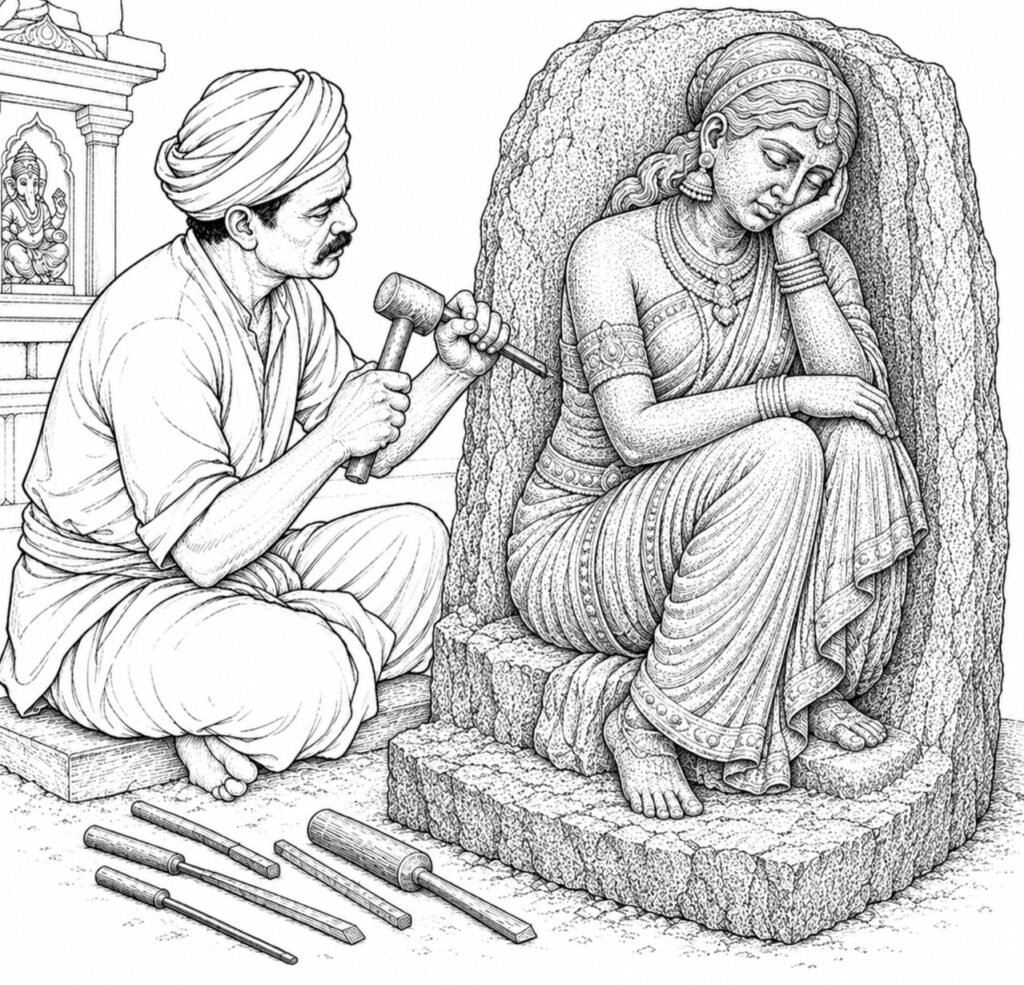
He apprised the sculptor of his mood, stating that he needed a statue of a weeping woman. The sculptor fell into a dilemma. His ever-smiling wife was never known to shed tears. She had never wept. Now, scratching her eyes, the sculptor had to bring out tears. He had to overburden her feather-light mind and make it heavy. But how? How to feed wild mango to a banana eater? He was clueless.
Night was advancing. Though devoid of sleep, he still hadn’t found a way out. He cursed himself for some time. He struck his head many times. He was at his wit’s end. He knew why he had failed to arrange an outline of the statue, why no remedy struck him. He had to make the ever-smiling lady weep. But how?
The artist brooded, mulled, and reflected. The formula was out of his reach. He was unable to resolve his internal tussle. He was shameful within his mind, unable to digest it. In the eyes of the world, he was a great artist, but if the public knew of his present state a gossip was sure to ensue.
The night was advancing. The sculptor was unable to sleep. He must catch a wink. He lay still, closing his eyes. He supplicated for sleep. At last, sleep took pity on him, and he fell into a deep slumber.
The next morning, he woke up feeling refreshed. He kneaded his thoughts awhile and eventually an idea bubbled. At once he pounced on it. ‘The evil time of the lady will arrive. She will cry automatically.’
His charming wife used to forget herself in his love for her. He would strike her hard at the right spot.
He arranged a beautiful girl and flirted with her openly in front of his wife. The hammer struck hard at the right spot. His wife was shattered, as if she had ceased to love life itself. She felt the jolt of betrayal. The ideas she had clung to for years collapsed.
The artist gathered the scene he was waiting for. He stared at his wife intently.
Face desolate. Eyes tormented. Hair unkempt. Body neglected. Getup graceless. Chubby, smiling lips shrivelled, mumbling something in a state of distress.
The sculptor got a perfect picture of his desired figure. He devoted himself to his sculpture. It came out perfect.
At once he ran to his wife. Explaining to her the story from beginning to end, he extended his hands to embrace her. His wife fell listless in his arms. The artist shrieked. Embracing her lifeless body, he rubbed his face against her face. He wailed uncontrollably.
Suddenly his crying stopped. His wife was in his arms. His breathing also stopped.
Just then the king arrived. He was overjoyed seeing the statue. His imagination had been replicated perfectly.
He hastened to congratulate the artist. But the sculptor had taken leave for good, presenting his last craft.
The storyteller wrapped up the story. He cast aside his pen. Maybe, this could be his last story as well. The milestone of a hundred-year life span was inching towards him.
Although the title initially reminded me of The Last Leaf by O. Henry, the story unfolds magnificently as a Borgesian piece of metafiction.
I am simply overwhelmed.
Many happy returns of the day, Achyutananda Pati Sir.
Happy Birthday!
May both of you—Sir and Sukomal—live far beyond the years of our counting, in your works, in your words, and in the memories of your readers.
🙏🙏🙏
ଧନ୍ୟବାଦ ସାର୍। ଆପଣଙ୍କ ଆଶୀର୍ବାଦ।
A really engrossing story from the centenarian maestro!
The impeccable English rendering has added unique flavour to the crisply sculpted short story!
I was tearfully overwhelmed ! The anticlimax did give a sweetly painful cathartic nudge , not a jolt!
The storyline of the maestro is extraordinarily fantastick!
Kudos to the translator’s tapestry of well chiselled phrases that enhanced the aroma of the timeless beauties in stone, as well as the deft denoument crafted by the ever venerable storyteller Achyutananda Sir who materialised magnificently through the undulating story craft with a magnificent pen in his hand that keeps on metamorphosing back and forth to a surreal mythical chisel ! Awesome, Fantastick!
ସାଦର ସାଷ୍ଟାଙ୍ଗ ପ୍ରଣାମ, ଅପ୍ରତିମ କଥାକାର ଆମ ସମୟର !!
ଶୁଭାଶୀଷ, ପ୍ରତିଭାବାନ ଅନୁବାଦ ଶିଳ୍ପୀ ସୁକୋମଳ ବାବୁ !
ଅଭିନନ୍ଦନ, ସାହିତ୍ୟଚର୍ଚ୍ଚା ପତ୍ରିକାର ଶ୍ରଦ୍ଧେୟ ସମ୍ପାଦକ ମହାଶୟ !
ସାର୍ ନମସ୍କାର। ଆପଣଙ୍କ ଆଶୀର୍ବାଦ ଥାଉ🙏